

Enterprise Singapore has just released its Business Refresh Package, and the headline is a big one.
From the second half of 2026, a new unified grant called EDGE will replace three of EnterpriseSG’s flagship schemes: the Enterprise Development Grant (EDG), Market Readiness Assistance (MRA), and Productivity Solutions Grant (PSG).
It’s the most significant structural change to Singapore’s enterprise grant landscape in years.
But EDGE is only part of the story. The package also raises support levels across the board, lifts financing caps, expands eligibility to non-SMEs for the first time in several schemes, and removes longstanding restrictions that have limited how businesses can use grant funding.
Here’s what’s changing, what it means, and what you should be doing about it now.
EDGE: One Grant to Replace Three
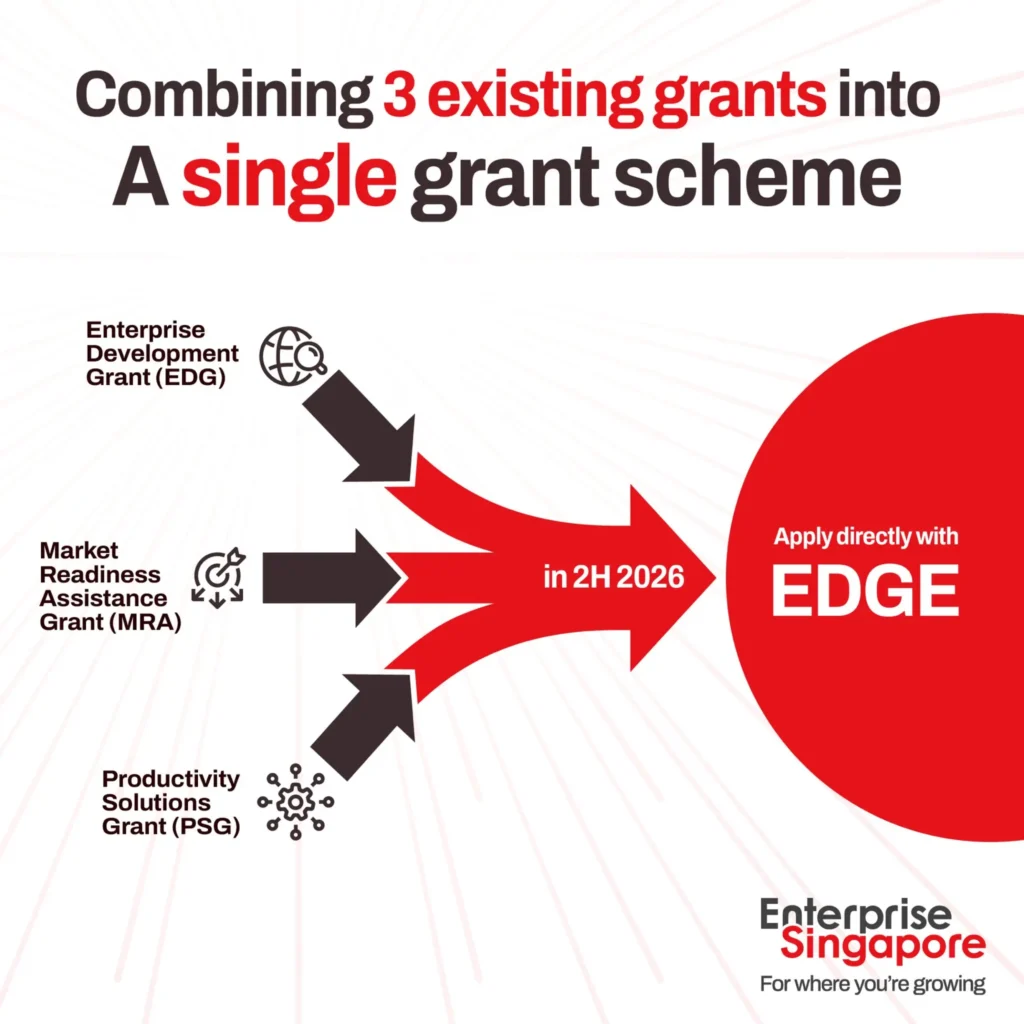
For years, Singapore’s grant system has been powerful but fragmented.
Want to expand overseas? Apply for MRA. Need a productivity solution? That’s PSG. Working on a larger transformation project? You’ll need EDG. Each had its own eligibility criteria, application process, and approval timeline.
For many SMEs, the complexity of navigating three separate schemes was itself a barrier to accessing support.
EDGE changes this entirely.
How It Works
Instead of figuring out which grant your project falls under, you’ll apply based on what you want to achieve, whether that’s enhancing digitalisation capabilities, expanding into new markets, or improving operational efficiency.
One application. One framework. No more guessing.
Key Details
- Up to S$100,000 per year for eligible activities
- Open to all Singapore businesses, including non-SMEs
- Companies needing support beyond S$100,000 can submit applications to EnterpriseSG for case-by-case assessment
- All MRA enhancements (removal of “new market” criterion, extended eligibility) will fold into the EDGE framework once it goes live
Who Can Apply
Any business entity registered in Singapore. Additional requirements may vary by activity. EnterpriseSG will release more details closer to launch.
What Happens to Existing Grants?
EDG, MRA, and PSG remain fully accessible via the Business Grants Portal until EDGE launches. If you have projects in the pipeline, there’s no need to wait. Apply under the current frameworks now.
What Else Is Changing: Scheme by Scheme
Beyond EDGE, the Business Refresh Package delivers a wide set of enhancements to existing schemes. Here’s the full rundown.
Market Readiness Assistance (MRA): The Biggest Winner
The MRA grant has arguably seen the most meaningful set of changes in this package.
From 1 April 2026:
- Support levels for local SMEs jump from 50% to 70% of eligible costs (applicable until 31 March 2029)
- The enhanced grant cap of S$100,000 per company per new market is extended
From H2 2026 (when EDGE launches):
- Local non-SMEs become eligible for MRA-equivalent support for the first time, at up to 50% of eligible costs
- The long-standing “new market” criterion is removed, meaning businesses can now use MRA funding to deepen their presence in overseas markets where they already operate
That last point is worth pausing on.
For years, MRA was strictly a market-entry tool. If you were already generating revenue in a market, you couldn’t tap MRA to scale further in that same market. That restriction is now gone.
For companies with established footholds in Southeast Asia, North Asia, or beyond, this opens up a meaningful new funding avenue for scaling activities, such as hiring local sales teams, running in-market campaigns, or setting up distribution partnerships.
Enterprise Development Grant (EDG): What Changes Under EDGE
For businesses familiar with EDG, the transition to EDGE raises an important question: what happens to the larger, more customised transformation projects that EDG has traditionally supported?
The short answer: the project types don’t go away. Activities currently funded under EDG (business strategy development, process redesign, productivity improvements, market access, and more) will continue to be supported under EDGE.
What changes is the structure.
Under EDGE, projects up to S$100,000 per year will go through a streamlined, simplified application process. This is good news for smaller-scale EDG-type projects, which should see faster approvals and less administrative friction.
For larger projects that exceed the S$100,000 annual cap, businesses can still apply to EnterpriseSG for additional support, assessed on a case-by-case basis. These are the higher-value transformation projects that require detailed proposals, clear scoping, and strong justification, much like current EDG applications.
In practice, this creates a two-tier system:
- Standard tier (up to S$100K): Simplified process, faster turnaround, accessible to more businesses including non-SMEs
- Custom tier (above S$100K): Requires a dedicated application to EnterpriseSG, with deeper assessment. This is where businesses pursuing serious transformation, multi-phase projects, or large-scale upgrades will continue to operate.
The bottom line: EDG as a brand may be merging into EDGE, but the need for well-structured, professionally prepared grant proposals for larger projects isn’t going anywhere. If anything, the two-tier structure makes the distinction between simple applications and complex transformation projects even clearer.
A Closer Look: EDG Core Capabilities Projects
For many Singapore SMEs, the most impactful EDG projects fall under the Core Capabilities pillar. These are the foundational projects that strengthen how a business operates, competes, and grows. They include:
- Business Strategy Development: Formulating or refining your growth strategy, entering new segments, restructuring business models, or developing a roadmap for the next phase of growth. This is especially relevant for companies at an inflection point, whether that’s scaling from S$5M to S$20M in revenue, pivoting to new markets, or preparing for investment.
- Financial Management: Strengthening financial controls, implementing budgeting and forecasting frameworks, or setting up management reporting systems. For companies that have grown quickly but still run on spreadsheets and gut feel, this can be transformative.
- Human Capital Development: Designing HR frameworks, talent management strategies, performance management systems, or leadership development programmes. As businesses scale, the gap between “we hire when we need someone” and a structured people strategy becomes a real bottleneck.
- Service Excellence: Improving service delivery models, customer experience frameworks, and operational workflows to drive retention and repeat revenue. Particularly relevant for B2B services, F&B, and retail businesses looking to differentiate on experience rather than price.
- Strategic Brand and Marketing Development: Building or repositioning your brand, developing go-to-market strategies for new products or markets, or creating a digital marketing framework. This goes beyond “run some ads” and into the strategic layer of how your business is perceived and positioned.
What makes Core Capabilities projects powerful is that they address the issues most business owners know they have but keep putting off: the strategy that’s still in the founder’s head, the financial systems that haven’t kept up with growth, the HR processes that don’t exist yet, the brand that needs a proper reset.
These aren’t technology projects. They’re business-building projects. And with government co-funding of up to 50% for SMEs (and potentially higher support during enhanced periods), there’s rarely a better time to invest in getting these foundations right.
The catch? A strong EDG Core Capabilities application requires more than filling in a form. EnterpriseSG evaluates proposals on the clarity of your business case, the credibility of your project plan, the quality of your consultant, and the measurability of your outcomes. Poorly scoped proposals get rejected. Well-prepared ones get approved and deliver real results.
If you’re considering a Core Capabilities project, whether it’s a business strategy refresh, a financial management overhaul, or a brand repositioning exercise, having an experienced partner who understands how EnterpriseSG evaluates these proposals can make the difference between an approval and a rejection.
Global Innovation Alliance (GIA): Refreshed and Restructured
The GIA has been quietly redesigned with a clearer progression model.
Support levels increase to 70% for SMEs and 50% for non-SMEs (up from 50% and 30%), applicable until 31 March 2029.
More importantly, the programme now offers two distinct pathways:
- “Launch” programmes for startups new to a market, offering market insights, short-term sprints, and early customer and partner discovery to test product-market fit
- “Grow” pathways for startups ready to scale, facilitating deeper partnerships for market penetration, technology maturation, and expansion
This is a welcome evolution.
Previously, GIA was often perceived as a one-size-fits-all programme. The new structure better reflects the reality that a startup entering Japan for the first time has fundamentally different needs from one that’s been in-market for two years and is looking to scale.
Enterprise Financing Scheme (EFS): More Headroom, Fewer Bottlenecks
Several EFS facilities have been enhanced:
EFS-Trade Loan: The facility-level caps (previously S$10M per borrower, S$20M per borrower group) are being removed from 1 April 2026, replaced by a single combined borrower group maximum of S$50M across all EFS facilities.
EFS-SME Fixed Assets: Similarly, the previous caps of S$30M per borrower and borrower group are being removed, subject to the same combined S$50M limit.
EFS-M&A: The temporary expansion to include domestic M&A activities, introduced during Budget 2022 and set to expire 31 March 2026, is now permanent. This is a meaningful change for companies pursuing inorganic growth strategies, whether through acquiring complementary businesses locally or overseas.
EFS-Green: Extended for five years (1 April 2026 to 31 March 2031), supporting financing for the development or adoption of green technologies and solutions.
Double Tax Deduction for Internationalisation (DTDi): Bigger and Simpler
From YA 2027, the expenditure cap for claims filed without prior approval increases from S$150,000 to S$400,000 per YA.
The scope of automatic claims also expands to cover overseas market development trips, investment study trips, and five additional qualifying activities, including feasibility studies, overseas business development, and master licensing/franchising.
For businesses already spending on internationalisation, this is a straightforward reduction in administrative burden.
You no longer need to seek prior approval from EnterpriseSG or STB for most mid-sized expansion budgets.
Business Adaptation Grant (BizAdapt): Higher Support for Tariff-Impacted Businesses
From 1 April 2026, BizAdapt support increases to 70% for SMEs (up from 50%) and 50% for non-SMEs (up from 30%), running until 6 October 2027.
The grant continues to focus on advisory and reconfiguration support for businesses impacted by tariffs, helping them adapt operations and build supply chain resilience.
Energy Efficiency Grant (EEG): Extended One More Year
The EEG continues to offer two tiers of support: a Base tier of up to S$30,000 for pre-approved equipment, and an Advanced tier of up to S$350,000, across six qualifying sectors.
It has been extended from 1 April 2026 to 31 March 2027.
Heartland Enterprise Support: EVM and HEPG Enhanced
For heartland businesses, both the Enhanced Visual Merchandising (EVM) Programme and the Heartland Enterprise Placemaking Grant (HEPG) see their support levels raised from 50% to 70% from 1 April 2026.
What Should Businesses Do Now?
The Business Refresh Package creates both immediate opportunities and a transition to plan for.
If you have projects ready to go: Apply now under the current EDG, MRA, or PSG frameworks. The enhanced support levels (70% for SMEs) take effect from 1 April 2026, and existing grants remain fully accessible via the Business Grants Portal until EDGE launches.
If you’re expanding overseas: The removal of MRA’s “new market” criterion is a game-changer. If you’ve been self-funding your scaling activities in existing markets, you can now tap government support for those same activities once EDGE goes live. Start planning your applications now.
If you’re planning a larger transformation project: Don’t assume EDGE’s S$100K cap limits what you can do. Customised projects above that threshold can still be submitted to EnterpriseSG. The key is having a well-prepared proposal with clear outcomes, which is exactly what the current EDG process has always required.
If you’ve avoided grants due to complexity: EDGE was designed with you in mind. The unified framework should significantly reduce the friction of applying. Watch for EnterpriseSG’s launch announcements in H2 2026.
If you’re a non-SME: Pay attention. Several schemes (MRA, BizAdapt, GIA) are opening up to non-SMEs for the first time or increasing non-SME support levels. This package isn’t just for small businesses anymore.
Looking Ahead
The Business Refresh Package is best understood as the implementation layer for Budget 2026’s enterprise ambitions.
Where the Budget set the strategic direction (AI transformation, internationalisation, pro-enterprise environment), this package delivers the operational details.
For businesses, the message is clear: the Government is investing heavily in making it easier and more rewarding to grow, transform, and go global.
The question is whether your business is positioned to take advantage of it.
Source: EnterpriseSG Business Refresh Package Factsheet (March 2026)